
I’m living proof of the profound impact of organ donation
In honor of National Donate Life Month, a columnist shares his story
Written by |

A single decision, likely made in a split second by someone I’d never met, saved my life. On the morning of July 9, 2021, I received a call that donor lungs were available for me, and my future went from impossible to possible.
When I was diagnosed on Jan. 31, 2017, with idiopathic pulmonary fibrosis (IPF), a disease I’d never heard of, I learned that it is chronic and progressive and has no cure. The prognosis I was given of three to five years could be delayed, doctors said, by one of two anti-fibrotic medications available to IPF patients at the time.
The best possibility to live beyond the prognosis was a lung transplant, which could extend my life. But it requires a lifetime of medical surveillance and a daily medication regimen that many patients find daunting. Pursuing a lung transplant was a choice I made that allowed me to be here today.
That choice was only possible because of organ donation. I don’t know whether my donor indicated their choice on their driver’s license or if they registered during a campaign to enroll organ donors. Perhaps their family made the decision when my donor passed.

Becoming an advocate
I’ve written my donor family over the years since my transplant. Direct communication is not initially allowed between an organ recipient and the donor family. The letters I send are exchanged between organ procurement organizations. The organization associated with the donor family lets them know they’ve received a letter from me. They can either accept or decline that letter.
Grief doesn’t have a timeline set in stone, and it often lingers. I don’t know anything about my donor, including the circumstances of their passing. I don’t know if their family was aware that they’d made the decision to donate their organs.
When I received my bilateral lung transplant on July 10, 2021, it changed my future. My oldest granddaughter, Abigail, was born in January 2018. Since then, Charlotte and Brooklyn joined her, and now there are three.
My wife, Susan, and I have traveled across the U.S. via Amtrak, taking in the scenery from a train window. We gave up traveling on large cruise ships, taking smaller, less-crowded river cruises instead.
I’ve dedicated much time and energy to raising awareness about IPF and other associated interstitial lung diseases and the need for more people to sign up for organ donation. When I was diagnosed and elected to pursue the possibility of a transplant, my father-in-law signed up to be an organ donor.
April is National Donate Life Month. You can register to become an organ donor through the agency responsible for issuing driver’s licenses in your state. You can also register online at the Donate Life in your state or through Donate Life’s national registry.
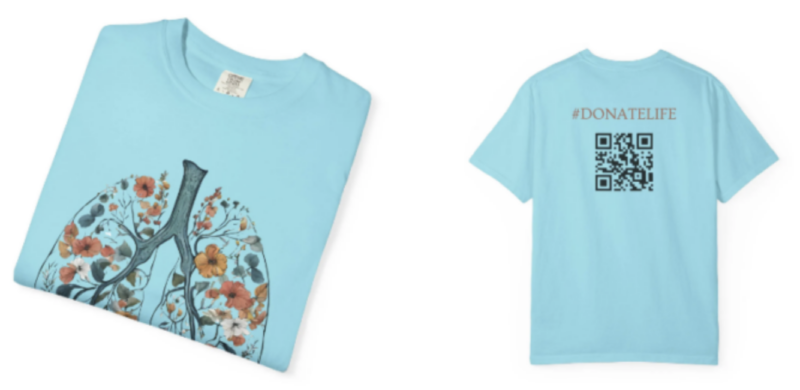
The T-shirt that columnist Sam Kirton uses to advocate for organ donation. (Photos by Samuel Kirton)
An organ donor can save up to eight lives and can enhance the lives of 75 more people. According to data from the Health Resources and Services Administration, 108,440 people were awaiting transplants as of Dec. 1, 2025. Most of them (94,015) were awaiting a kidney transplant, while 977 were awaiting new lungs.
I would urge my readers to consider becoming advocates for organ donation. The more people there are in the donor pool, the more chances of success for someone awaiting a transplant.
Donate Life offers a section of frequently asked questions to help prepare people to advocate for organ donation.
I have a creative friend, Paloma Leigh, who operates an Etsy store called La Petite Randonneuse. She created a shirt for me with a beautiful set of lungs on the front and a QR code to Donate Life on the back. You might be surprised by how many people scan that QR code when I wear the shirt.
Please consider helping to raise awareness about the need for more organ donation and to dispel myths or misinformation about it. It could save a life — maybe even your own. Organ donation has allowed me to make every breath count.
Note: Pulmonary Fibrosis News is strictly a news and information website about the disease. It does not provide medical advice, diagnosis, or treatment. This content is not intended to be a substitute for professional medical advice, diagnosis, or treatment. Always seek the advice of your physician or other qualified health provider with any questions you may have regarding a medical condition. Never disregard professional medical advice or delay in seeking it because of something you have read on this website. The opinions expressed in this column are not those of Pulmonary Fibrosis News or its parent company, Bionews, and are intended to spark discussion about issues pertaining to pulmonary fibrosis.


Leave a comment
Fill in the required fields to post. Your email address will not be published.